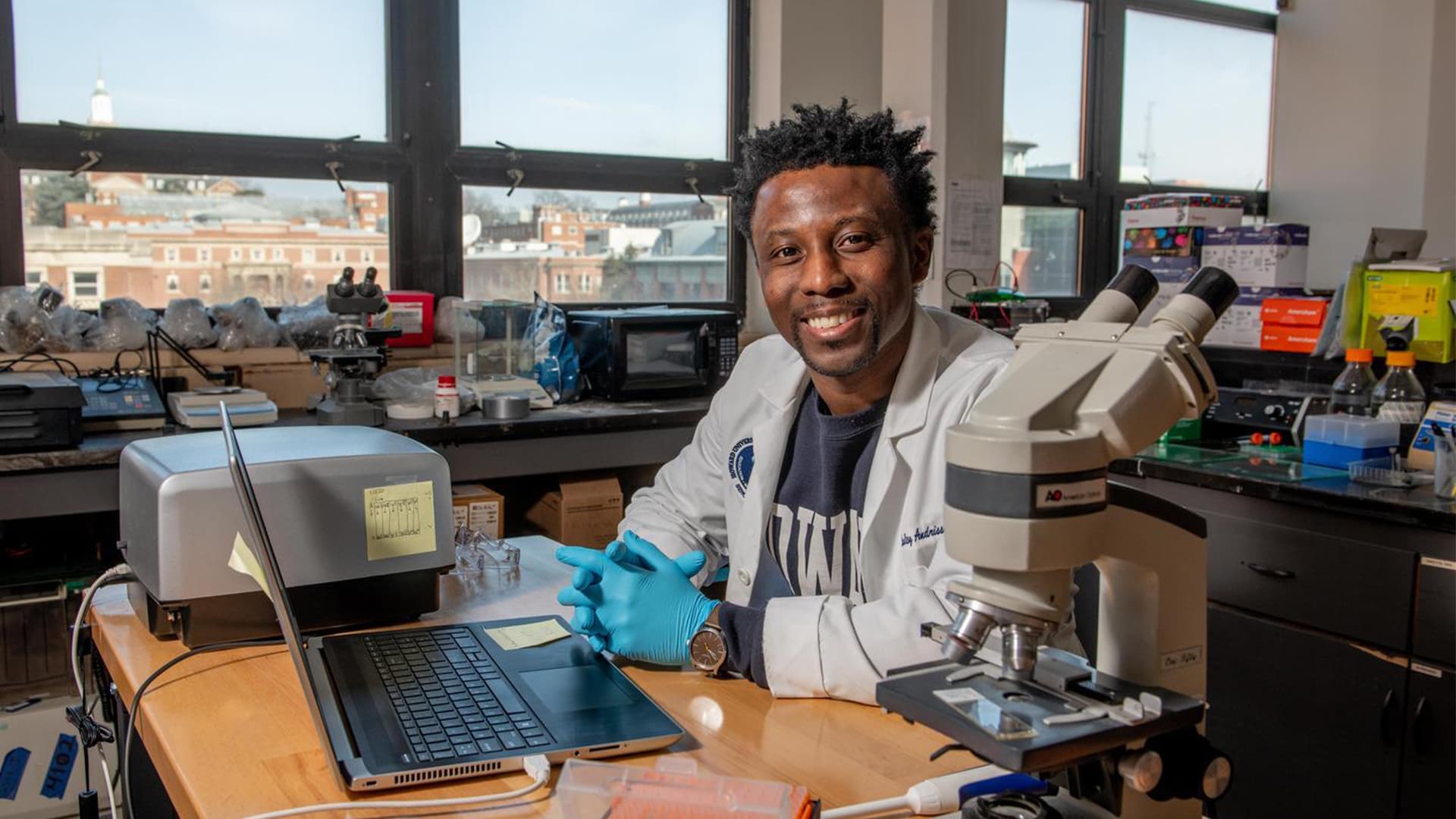
Your past doesn’t define you, and this doctor is a testament to that.
At 14 years old, Dr. Stanley Andrisse, MBA, Ph.D., raised in Ferguson, MO, was arrested.
By his 20s, he had accumulated three felony drug convictions, according to The Dig at Howard University (The Dig). Yet, despite this experience, he went from being incarcerated in a maximum-security prison to working as an endocrinologist, scientist, and tenured professor at Howard University College of Medicine.
The catalyst for rewriting his story occurred after losing his father to Type 2 diabetes while still incarcerated, according to a separate article from The Dig. That experience inspired him to learn more about the disease, prompting him to read his first scientific article.
“I decided to live differently and honor my father’s life by pursuing science,” he told the outlet.
Andrisse applied to various graduate schools after being released from prison and received various rejections. Fortunately, he received an acceptance from Saint Louis University. He had been mentored by biologist Barrie Bode, a professor at the university and member of its admissions committee, according to The Dig.
Andrisse earned a Ph.D. in physiology with focus on diabetes from Saint Louis University in 2014. He also completed a postdoctoral fellowship in pediatric endocrinology at Johns Hopkins School of Medicine in 2017, according to his faculty profile at Howard University.
In his lab at Howard University, his research focuses on the “intersecting pathways of different insulin-resistant states,” per his LinkedIn profile. He has also received support from multiple National Institutes of Health grants, his faculty profile notes.
Furthermore, at Howard University, the nation’s only R1-designated HBCU, he works in the department of physiology and biophysics as a tenured associate professor of physiology, and his teaching centers on endocrinology, insulin signaling, and energy metabolism.
“My story represents both possibility and responsibility, and it’s the culmination of years of faith, mentorship, and resilience. But it’s bigger than me. It’s proof that redemption is real — that someone who was once written off as a “career criminal” can stand in front of classrooms, lead research, and shape the next generation of scientists,” Andrisse said, according to The Dig. “To my knowledge, I’m the first formerly incarcerated Black man in U.S. history to earn tenure at a medical school.”
P2P Nonprofit
Today, Andrisse continues to pay it forward.
He is a founder and executive director of the nonprofit From Prison Cells to PhD (P2P), which makes college a possibility for formerly incarcerated individuals through reading workshops, paid mini internships, scholarships, mentorship, loan application assistance, and more, according to its website.
“When I was released, there was no clear roadmap for someone with my background to enter higher education. Every door came with a lock and a label,” Andrisse said, as reported by The Dig.
“I founded P2P to make sure others don’t have to navigate those barriers alone. Since then, we’ve supported more than a thousand justice-impacted scholars nationwide. The goal is simply to move people from conviction to contribution,” he added.