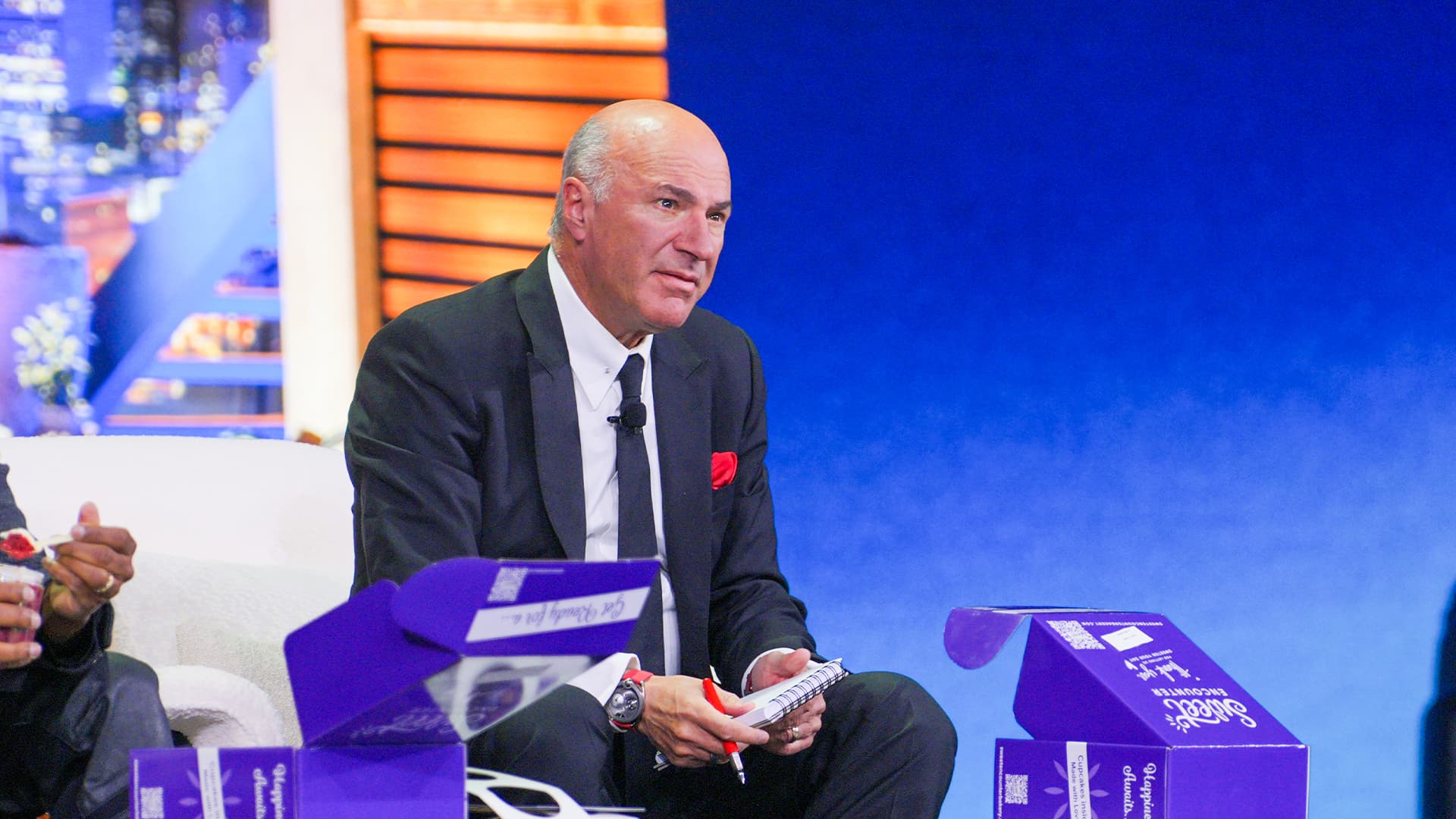
Every entrepreneur has a defining moment. For Canadian businessman and investor Kevin O’Leary, it occurred in the 11th grade.
O’Leary, nicknamed “Mr. Wonderful,” shared with AFROTECH™ that he was fired from an ice cream shop after working only a few hours as a scooper. The shop’s owner instructed him to scrape the tile floors, which he refused to do since it was not in his job description.
“She said, ‘You do whatever I want. I mean, you’re my employee.’ And she said, ‘You’re fired.’ And I said, ‘That sucks.’ I never worked for anybody again. That was it. So I owe her a lot,” O’Leary told AFROTECH™ during the Clover x Shark Tank Summit held in September Las Vegas.
He later added, “That’s when I realized… there are two types of people in the world. There are people that own the store, and there are the people that scrape the sh-t off the floor. Which one do you want? I’m not saying being an employee is bad. It’s just not for me. I can’t do it.”
O’Leary went back to find that manager years later, but the shop no longer existed and was later bulldozed. However, he keeps a brick from the building as a souvenir.
Becoming A Millionaire
O’Leary did stay true to his word of never working for someone else again. He would go on to attend the University of Waterloo, pursuing a degree in psychology and environmental studies, reports CNBC. In 1979, he attended the Ivey Business School at Western University to earn an MBA, taking the advice of his step-father, George Kanawaty. What was most beneficial from that program was not necessarily the knowledge he learned, but the networks and relationships that he can still bank on today, he told the outlet.
In 1986, O’Leary founded Softkey Products, a company that delivered software for educational and home productivity purposes. In the ’90s, the company made a slew of acquisitions, including Compton’s New Media, the Learning Co., Minnesota Educational Computer Co., Creative Wonders, Mindscape, and Broderbund, positioning it to generate over $800 million in yearly revenue, Fortune reports.
He sold Softkey to Mattel for $4.2 billion in 1999 and became a millionaire, according to the outlet.
Glimpse Into Portfolio
Today, O’Leary still sports his entrepreneurial hat with a handful of ventures. He’s the founder of O’Leary Fine Wines, and, in 2000, he established O’Leary Ventures, a private venture capital investment company aligned with his interest in passionate startups. According to his LinkedIn profile, he is also a strategic investor in WonderFi, a strategic advisor and investor at Tax Hive, and wears hats as the chairman of O’Shares Investments and Beanstox.
He has additionally invested in companies as a judge on “Shark Tank,” a post he has held since the show first aired in 2009. As AFROTECH™ previously told you, he invested in Kreyol Essence during the show’s 11th season. The company — founded by married couple Yve-Car Momperousse and Stéphane Jean-Baptiste — sells products with clinically tested Haitian Black Castor oil for hair loss, eczema, and dryness, according to its website. Through “Shark Tank,” the pair secured a $400,000 investment in exchange for a royalty of 25 cents for every unit sold in perpetuity and 5% in equity.
How To Be More Attractive To Investors
As O’Leary enters the show’s 17th season, which premiered Sept. 24, he has some advice on what founders should consider to be more attractive to investors.
“So it turns out what people are looking for in investing is the ability to be flexible and to pivot because no matter what your business plan is, something is gonna happen… What experience do you have in managing risk and volatility? Because there’s gonna be a lot of that. Whatever you thought was gonna happen is generally something else,” he explained to AFROTECH™.
In addition to managing risk, O’Leary pointed to being able to pursue your goals despite any distractions that may arise.
“How good are you at the signal? The signal is the three things you have to get done every day as an entrepreneur, and the noise is all the stuff that stops you from getting the three things done,” he continued.
“Now if I meet someone who can’t distinguish the signal from the noise, I don’t want to invest in them because they’re scatterbrained… They can’t get stuff done and they’re not good at it because they can’t distinguish. That’s what I’m looking for in an entrepreneur, ability to distinguish signal from noise,” O’Leary added.
State Of Venture Capital
O’Leary also weighed in on attitudes in venture capital (VC) as it relates to Black entrepreneurs. His thoughts differ from others in the field.
According to the “2025 State of Black Venture Report” by BLCK VC, the average fund size for Black-led firms was $59 million and the median was $20 million, compared to the industry-wide median of $50 million-$100 million. The report notes a barrier in access to capital and fewer resources for Black fund managers compared with their peers, which impacts deals, scale, and the bandwidth to support founders.
“There was a huge surge in fund creation around 2020 and 2021, but over the last two to three years, we’ve seen a sharp decline in new fund starts. So yes, it’s hard for everyone. But it’s doubly hard for Black fund managers,” Slauson & Co. Partner Austin Clements said in the report.
When asked about shifting attitudes in VC, O’Leary pointed instead to a broader shift in the landscape:
“It’s just gotten a lot tighter, because most VCs want businesses that have proven a model that they can just pour gasoline on,” O’Leary said.
“They don’t like the startup environment as much anymore, and they’re not willing to lose money for three or four years… They might tolerate a year or maybe 24 months maximum. So that’s why it’s harder, you’re right, but it’s not gender-based or race-based,” he continued.